Unofficial · 14th printing

A visitor's companion to

Crossroads

The park at the meeting of the ways. Written, photographed, and argued over by one devoted regular. The management has never once returned my letters, which I respect.

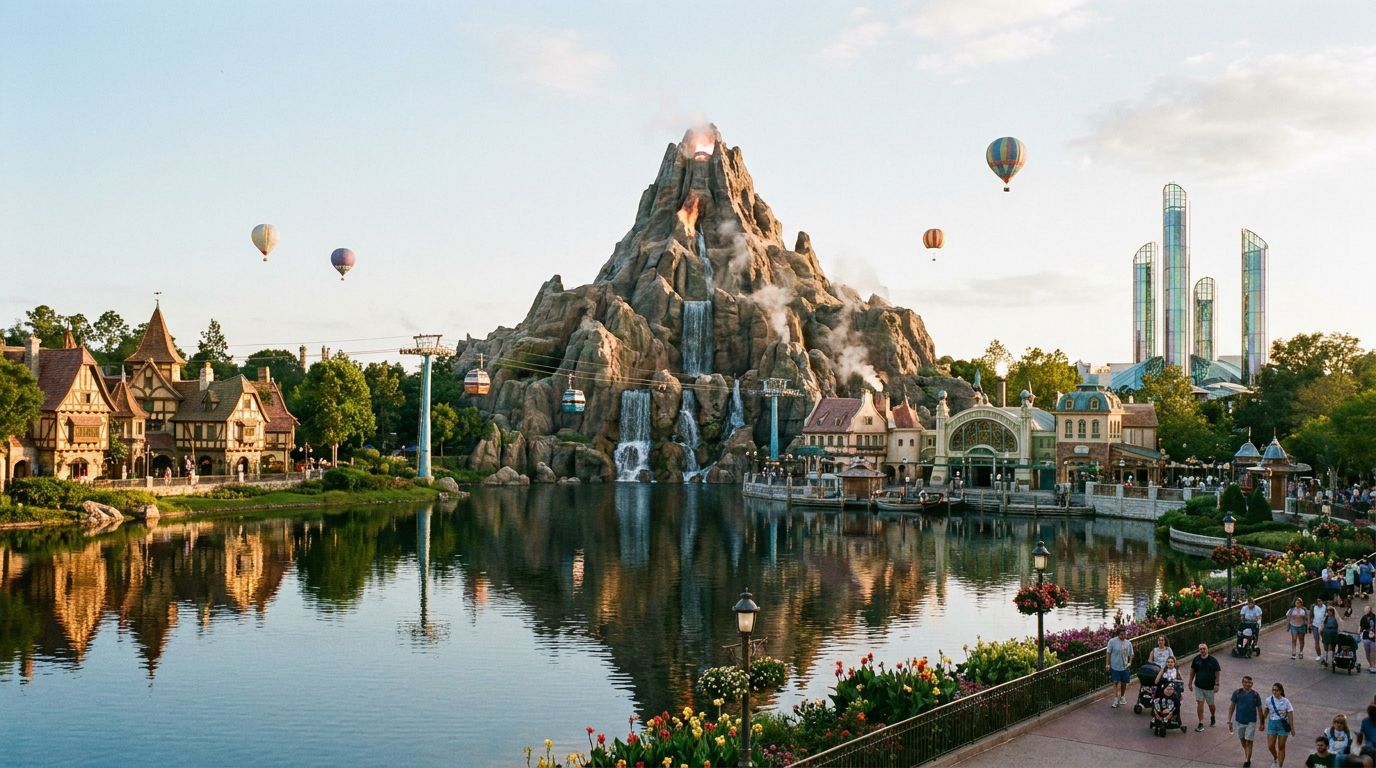
Panorama of Crossroads across its lake at golden hour: a landscaped mountain with waterfalls at center, a storybook village on the left shore, glass towers on the right, and a gondola lift crossing overhead.
The whole valley from the ferry deck, about seven in the evening. Nobody believes this photo isn't retouched. It isn't.

Chapter One · What this place is

A park that runs whether you're there or not

I have been coming to Crossroads for eleven years and I still can't tell you who owns it. What I can tell you: they sell 40,000 tickets a day into a valley built to hold three times that, the prices haven't moved since I started keeping receipts, and nobody has ever tried to sell me a photograph of myself.

The first thing you notice is what's missing. No lines worth complaining about. No upcharges. No sense, anywhere, that you are being harvested. It's unsettling for about an hour. Then it isn't.

I don't understand the business model. I've stopped asking. My working theory is that somebody with unreasonable money decided a park should be run the way a good village is run, and the accountants lost. This guide is my attempt to document the result before anyone comes to their senses.

Everything in this book is real somewhere — the coasters, the queue math, the gardeners. Just never all in one place. That's the trick of it.

0
Tickets a day, capped — in a valley built for 120,000
0
Longest posted wait I've personally witnessed
0
Costumed residents, spread across six lands, all busy
$0
Spent on upcharges in eleven years of trying to find one
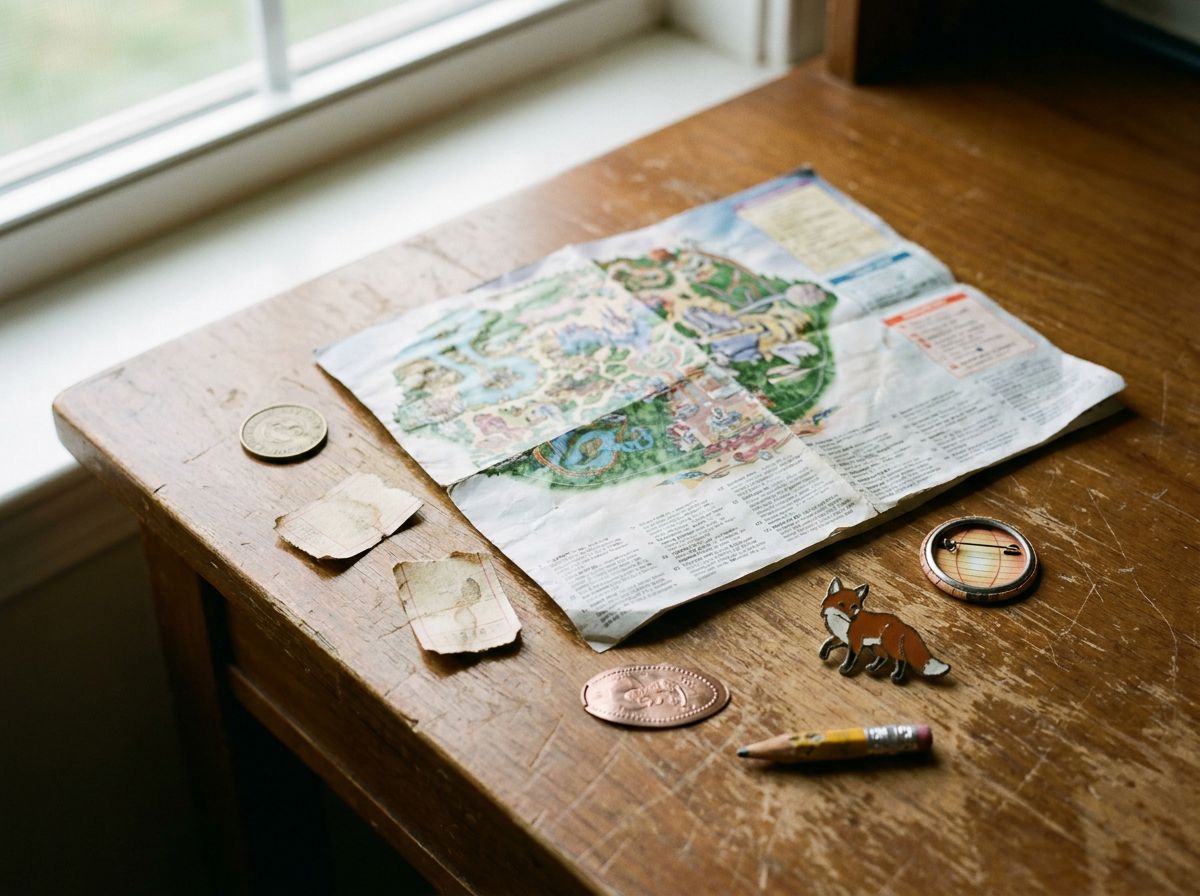
Flat-lay of keepsakes on a wooden desk: a creased park map, a brass coin, ticket stubs, a pressed penny, an enamel fox pin, and a pencil stub.
Eleven years of failing to throw anything away.

Chapter Two · The residents

They're not here for you.
That's the good part.

Other parks park their characters behind ropes and point them at your camera. The Crossroads residents have jobs, feuds, errands, and opinions, and they will get on with all four whether you watch or not. You don't queue to meet them. You just live in their village for a day, and sooner or later the village notices you back.

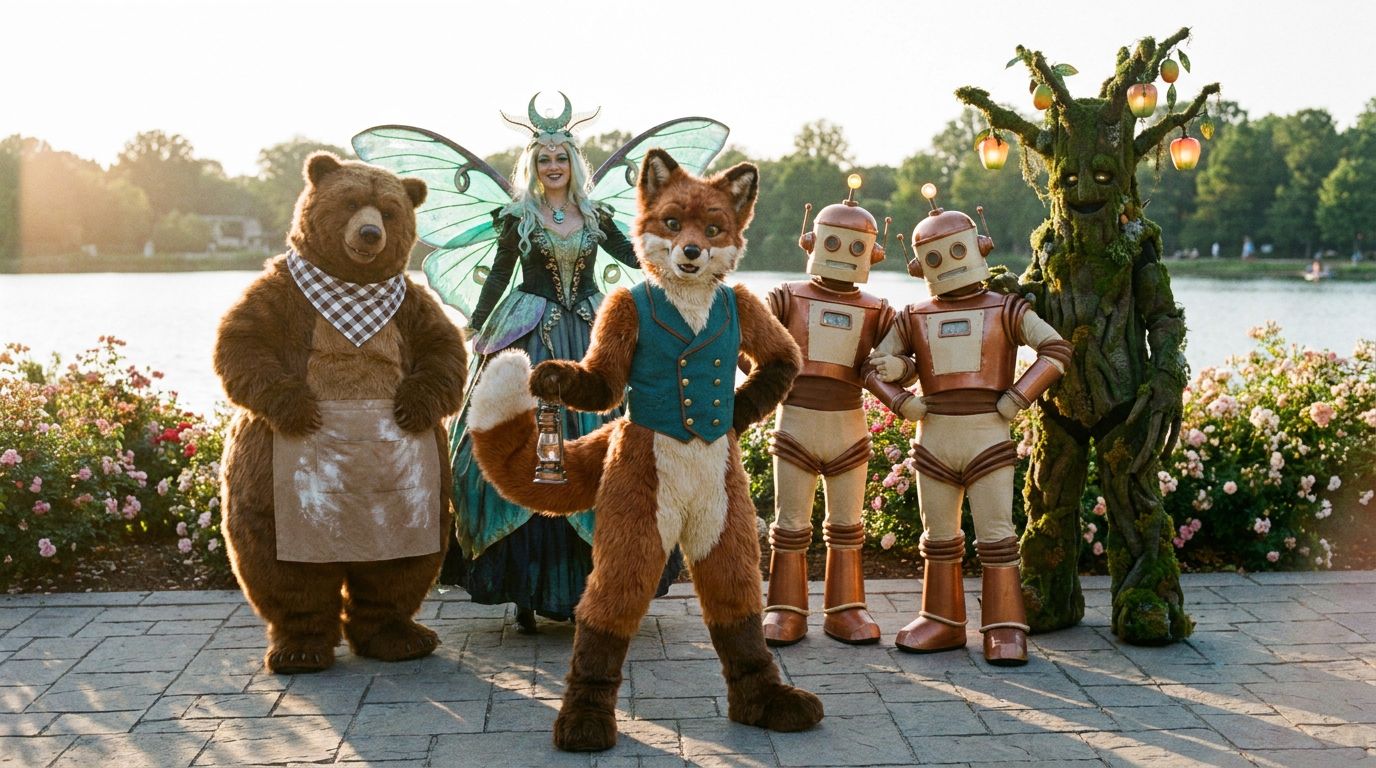
Five performers in beautifully crafted character costumes — a fox, a bear chef, a luna moth queen, two copper robots, and a walking tree — posed together on the lakeside promenade at golden hour.
The staff photo from the gatehouse wall. I asked for a copy three years running before someone finally slid one across the counter without a word.

Pip

The Lightkeeper

Keeps the gatehouse, leads the Order of the Lightkeepers out at dusk, and moves through the park like someone perpetually eleven minutes late who refuses to walk faster. Kneels to talk to children mid-errand, then carries on.

Passes the Bakehouse around nine most mornings. Don't quote me.

Marlowe

Chowder, Pier 4

The most famously surly cook in the park, which is why his line is the longest. Grunts, glares, remembers your order from last summer, and slides you an extra roll while maintaining unbroken eye contact with the horizon.

The glare is the affection. Locals know.

Tatters

Magpie-at-large

Steals cutlery, buttons, bad moods, and — famously, once — an entire wedding ring, which she returned at the couple's table that evening, polished. The park insists she is not on payroll. The park is lying.

Guard your spoon at Pier 4. Or don't. It's an honor, really.

Seren

The Evening Moth

Wakes the Undermere at 8:47 and speaks just above a whisper, which means everyone leans in, which I suspect is the point. Beautiful, unhurried, and about ten percent spookier than strictly necessary. The Undermere takes after her.

If she says your name, you'll think about it for a week.

Bolt & Rivet

The Twins of Skyward

Copper robots locked in a decades-long dispute about which of them invented the other. They fix things that aren't broken, unfix things that are, and can be bribed with sufficiently terrible jokes. The rivalry is real enough to have factions.

I'm Team Rivet. This guide is not neutral.

Grandmother Yew

The Oldest Resident

A walking tree who tells stories in the Hearthwood Glade three times a day, no two tellings alike, and keeps every drawing a child has ever handed her laminated among her branches. Claims to predate the park. The park does not argue.

The 4 PM telling is the good one. Earlier she's still warming up.

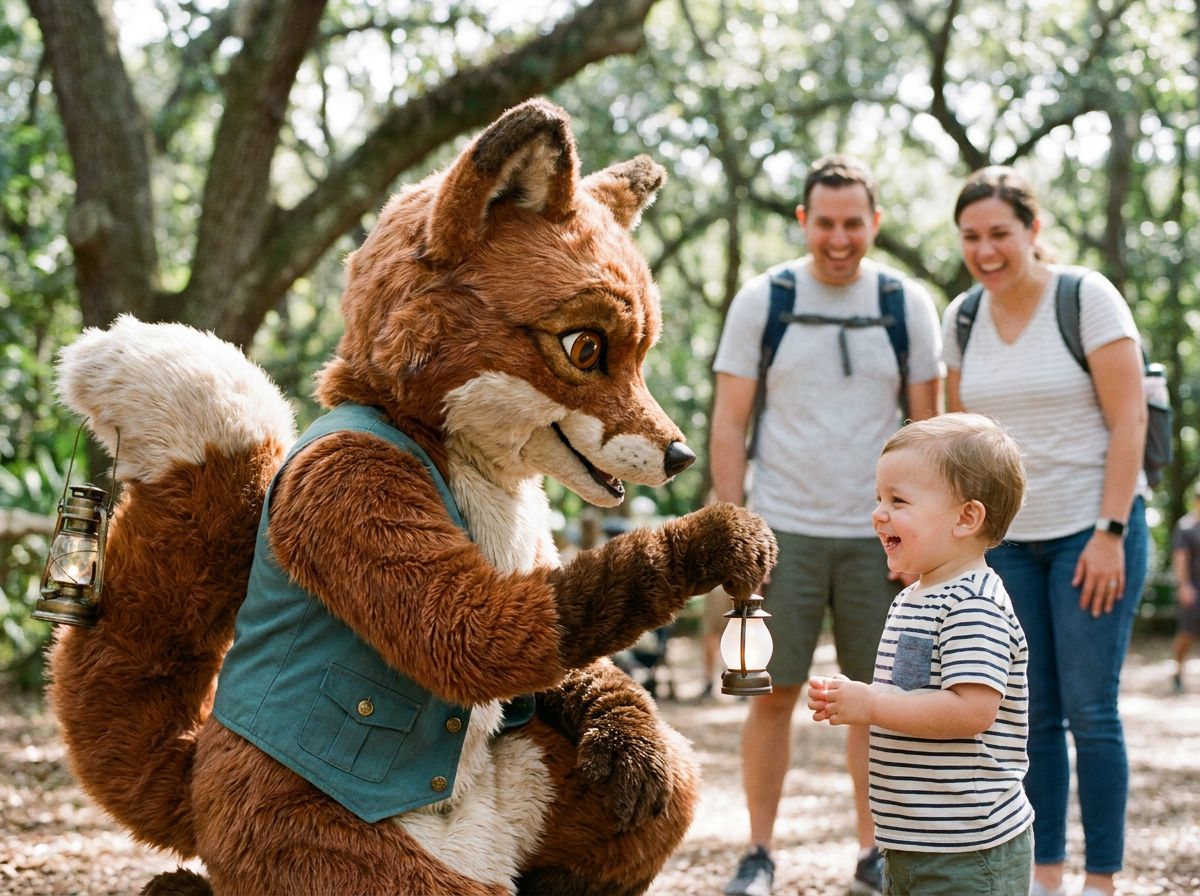
A performer in an immaculate fox costume kneeling at eye level with a laughing child in a sunlit clearing, handing over a tiny lantern charm.
Not staged. I checked with the parents.

Dusk, every day

The Lightkeeper's Rounds

At dusk the Order of the Lightkeepers — forty lamplighters in ember-orange robes, Pip at the front — fans out to light the park's 214 lanterns by hand. It is not a show. There's no announcement, no music cue. They're just… lighting the lamps, because it's evening, and the lamps need lighting.

Any kid who asks can carry the flame for one lantern, and their name goes in the Book of Lights at the gatehouse — volume 41 as of this printing. But here is my actual advice: don't chase the Order. Sit somewhere with a drink and let them pass you. The park lighting up around you while everyone else hurries is the best fifteen minutes of the day.

The lamplighters will absolutely detour for a kid having a bad evening. Mention it to anyone in a costume or an apron.

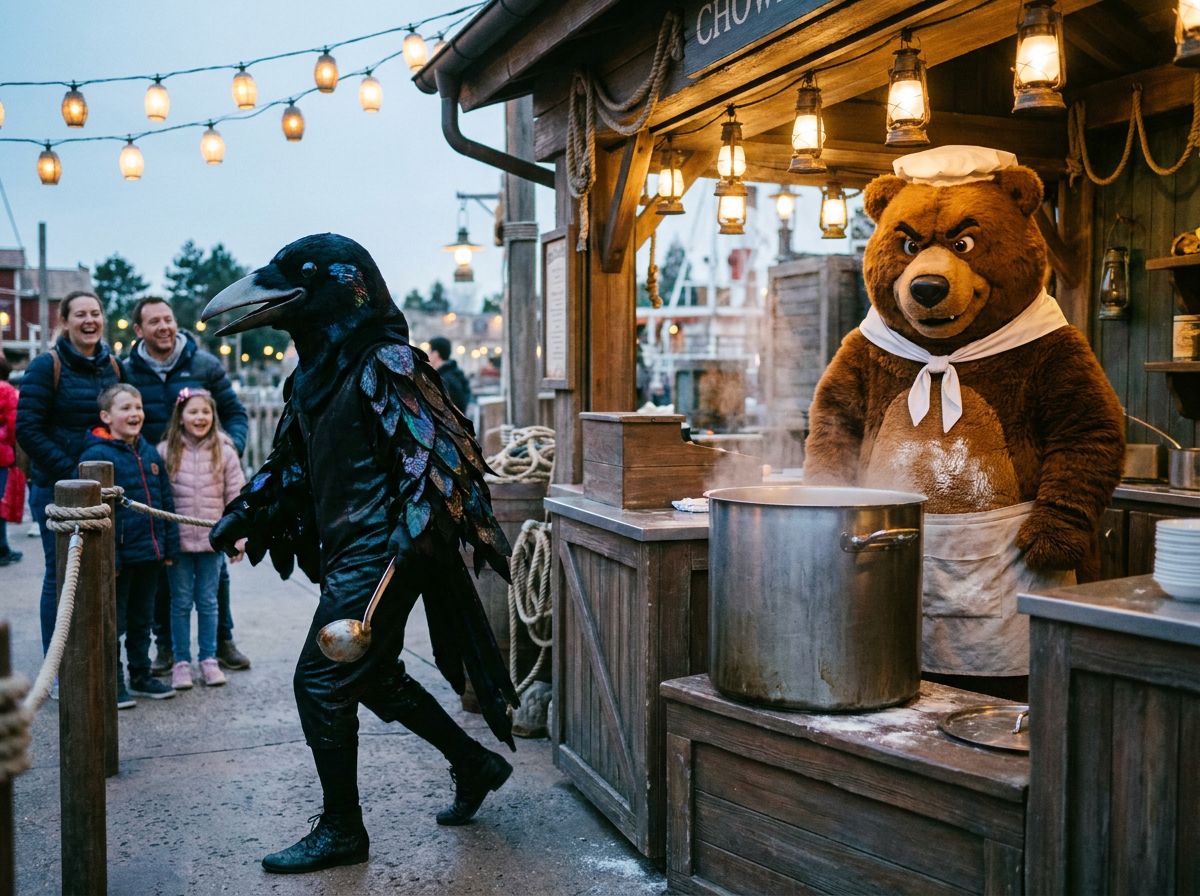
A performer in a glossy black magpie costume strutting along a food stall counter clutching a stolen silver ladle while a bear-chef character glares from behind a chowder pot.
The ladle war, day 3,000-something. Nobody is winning. Nobody wants it to end.

An ongoing situation

The Ladle War

Tatters has been stealing Marlowe's ladles for as long as anyone can document. Marlowe has escalated through chained ladles, decoy ladles, and — one legendary August — a ladle carved from ice. The magpie got that one too.

This is what I mean about the residents not being here for you. The war would continue in an empty park. Being nearby when a skirmish breaks out is not something you can book, schedule, or buy — which is exactly why the people who've seen one bring it up at parties for years.

Current score, per the Pier 4 bulletin board: Tatters 1,411 — Marlowe 3. The 3 are disputed.

A note on the brass coin

At the gate they'll offer you a small brass token, free, take it or don't. If you carry it, residents will sometimes remember you — your name, the lantern you carried in 2031, the joke you and the bear share. It's a transponder and an earpiece and a performer doing homework, the park is perfectly open about that, and it doesn't matter: being remembered feels the same either way. I carry mine. But plenty of regulars don't, on the theory that being nobody in particular in a busy village is its own kind of vacation. Both camps are correct.

You set the temperature

Wave and you'll get a wave. Stick out a hand, you'll get five. Hide behind your parent and the fox will crouch down at a polite distance and get very interested in something on the ground until you decide. Nobody here is ever chased or grabbed. The residents have somewhere to be anyway.

Busy is the baseline

Residents are usually mid-errand — hauling crates, arguing, delivering letters, chasing a magpie. You're welcome to fall in alongside. Half my best moments here were tagging along on someone else's business.

Calling hours

Every resident keeps a home base in their own land — the gatehouse, Pier 4, the twins' workshop, the grotto, the glade — with calling hours chalked on the door. Outside those hours they're out living their lives, and the note they leave is usually worth reading.

Honest magic

In character inside the gates, sure — that's the craft. But ask a sincere question and you get a sincere answer, and the park publishes how everything works, coin and earpiece included. The magic survives the explanation. That's how you know it's good.

Letters get answered

Anything dropped in any mail slot gets an answer, in-character, in ink. My niece has a nine-letter correspondence going with a magpie. The handwriting has gotten steadily worse, which she considers proof of authenticity.

The story moves

Storylines advance whether you're watching or not. Regulars have watched feuds cool, recipes change, and a certain robot factually and permanently win an argument (disputed). Come back after a year and things happened without you. That's not a slight. That's the point.

Chapter Three · The six lands

Laid out like a story, not a map

A forested berm rings the whole valley — from inside, the outside world flatly does not exist. The lands run around the lake with the mountain at the center of every sightline, pulling you inward like it's doing you a favor. It is.

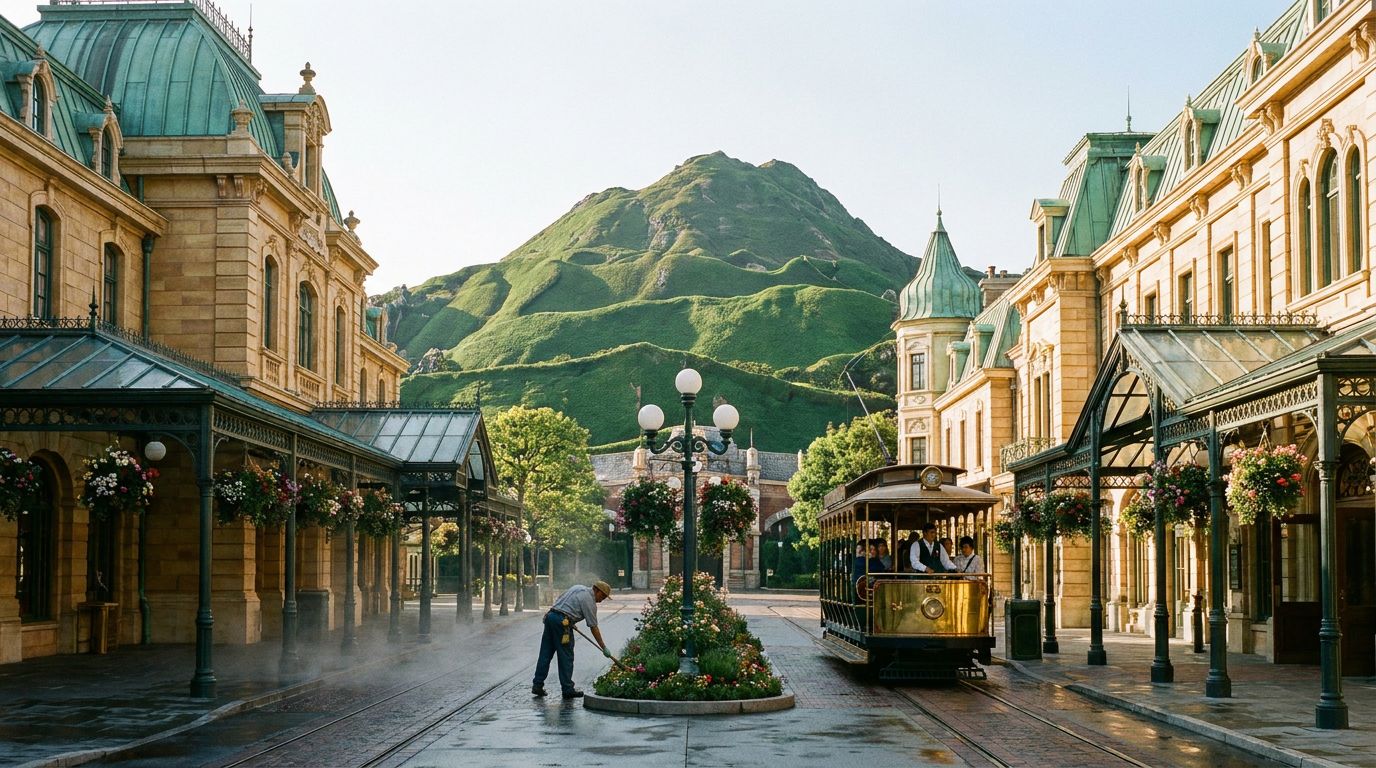
A grand car-free esplanade of honey-colored art nouveau facades with a brass tram, glass arcades, and a landscaped green mountain framed at the end of the street.
The Meridian at opening. The pavement is still warm from the night wash.

LAND I — THE THRESHOLD

The Meridian

The entry street, built on the old forced-perspective trick — smaller bricks the higher you look — so it feels taller and kinder than physics allows. Glass arcades for the rain, a brass tram for tired feet, one genuinely beautiful shop, and no other retail anywhere. Whoever decided a park needs only one shop deserves a statue. There is no statue. There's a flowerbed.

  • The Gatehouse — Pip's base, the Book of Lights on display, and the best noticeboard in the park.
  • The morning tram — ride it once, then never again; walking the street is the whole point.
  • The flag walk — the day opens with the residents, not a turnstile.
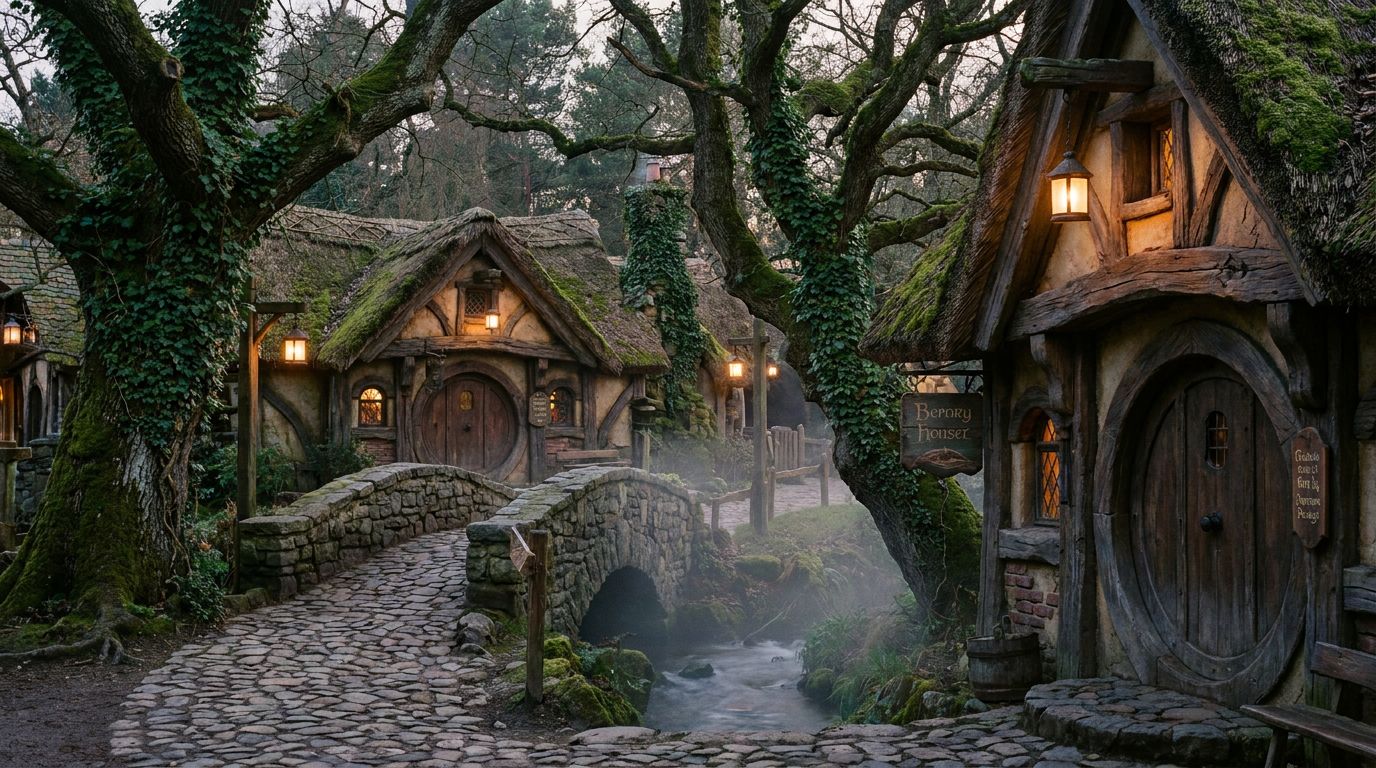
Storybook thatched cottages with round doors built between enormous mossy oak trees at dusk, lantern light in the windows, mist over a brook.
Hearthwood, blue hour. The mist is plumbed. I've made peace with it.

LAND II — THE STORYBOOK FOREST

Hearthwood

Grandmother Yew's homeland: cottages grown between real oaks, everything hand-painted and lovingly crooked, in the Efteling tradition of building attractions into a forest instead of on top of one. The Fable Cottages along the brook keep calling hours chalked on their doors; half the time the resident is out, and the note explaining why is better than most parks' shows.

  • The Glade — Yew's story circle. Go at 4 PM; see margin note in Chapter Two.
  • The Fable Cottages — read the door notes even if you knock on nothing.
  • The Long Way Home — the boat ride. See Chapter Four. Bring the cocoa money; it's $2.
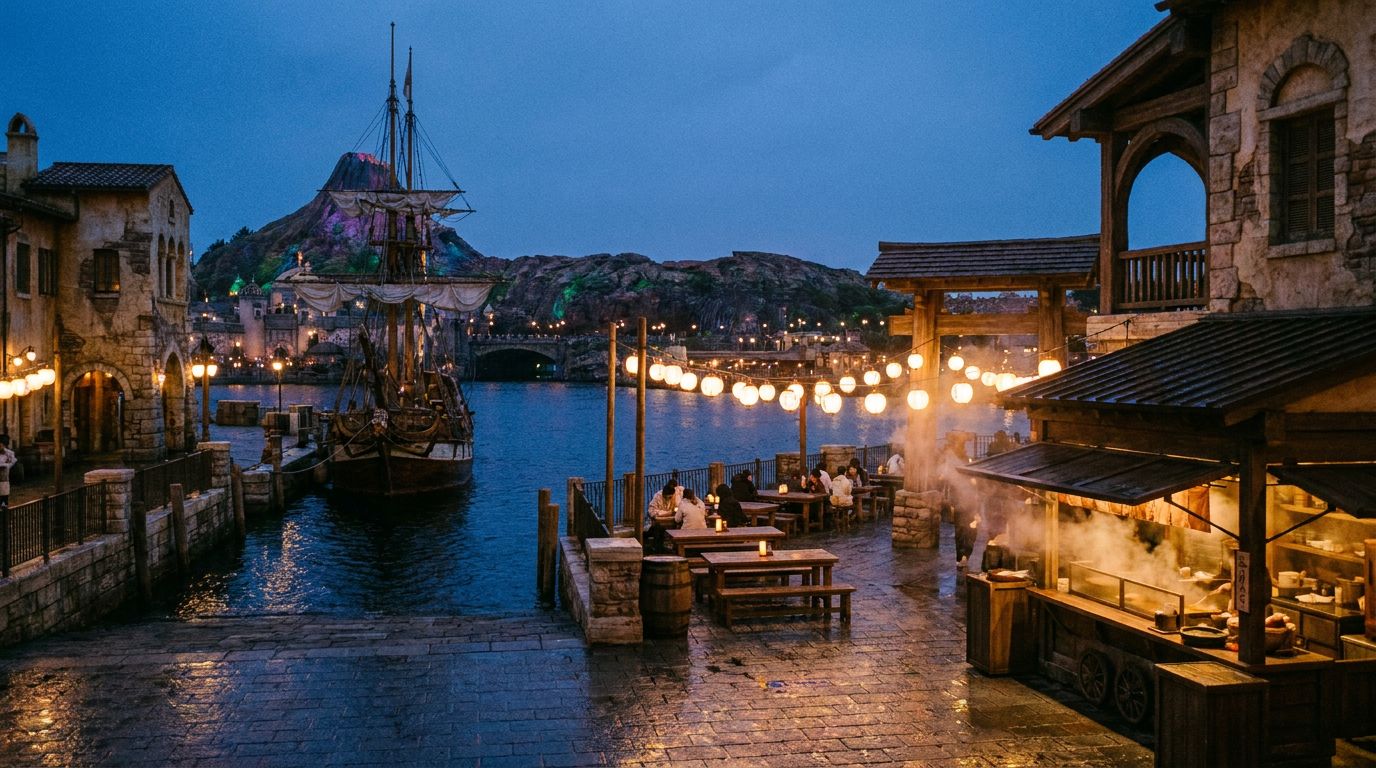
A harbor district at blue hour with stone quays, strings of paper lanterns, steam rising from food stalls, and a tall ship moored across the water.
Pier 4 from across the harbor. Marlowe's is the stall with the line and the glaring.

LAND III — THE TABLE

Tidegate Harbor

The food capital, and the land that runs most visibly on its own clock: boats unload at eleven, the tide organ plays at one, the night market lights at six, and none of it waits for you. There's a tall ship you can board and a lighthouse nobody will explain. My advice is to eat dinner here every single night of your trip and lie to yourself about trying somewhere else tomorrow.

  • The Night Market — forty stalls, each with a named cook and a specialty. Chapter Five is entirely about this.
  • The tide organ — the harbor plays itself at one o'clock. Stand near the sea wall.
  • The ladle war — active theater, Pier 4, unscheduled.
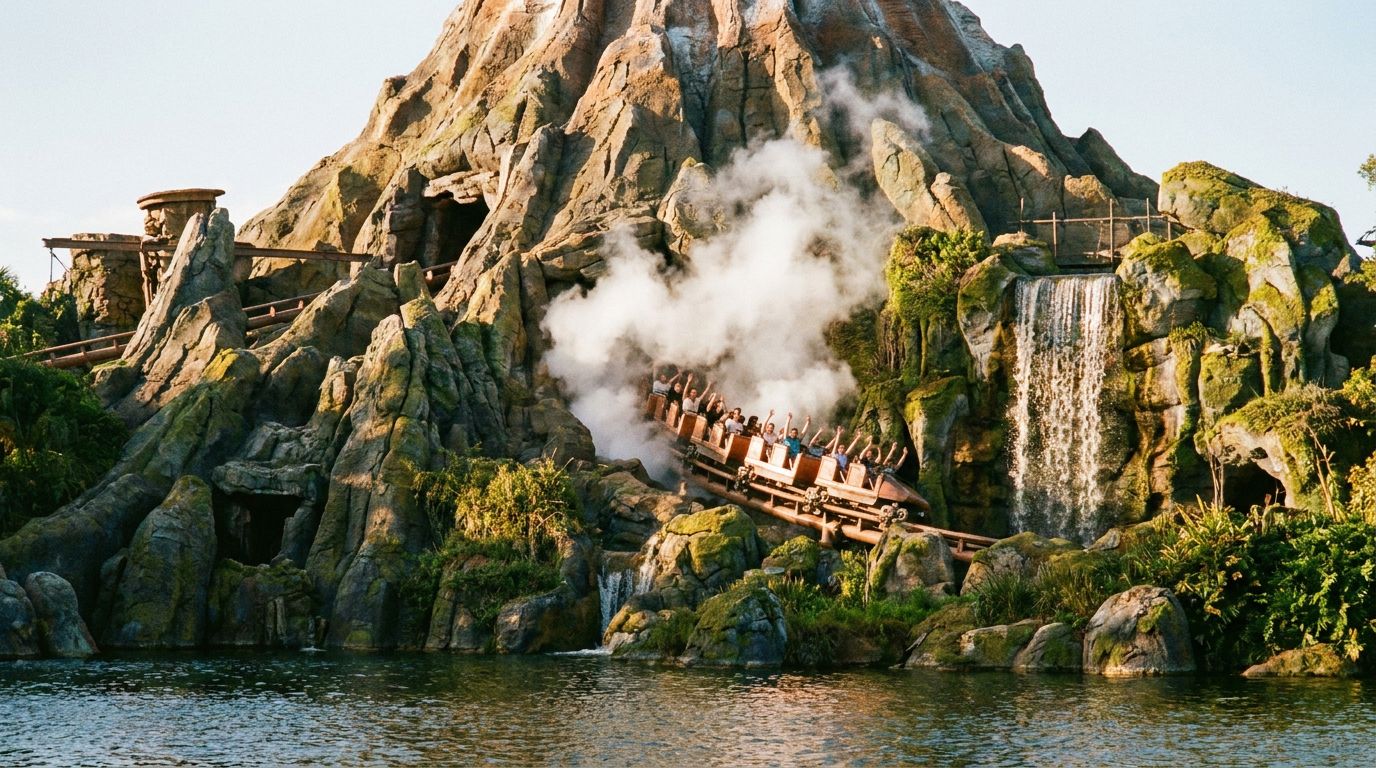
A launch coaster train bursting from the side of a massive landscaped volcano through white steam, diving toward a lake past a waterfall.
The Kindling exiting the steam vent. Sit left. Trust me.

LAND IV — THE MOUNTAIN

Emberpeak

The center of the valley and of every photo you'll take: a landscaped mountain laced with waterfalls, glowing seams, and 1.9 miles of coaster threaded through its guts. It breathes steam at dusk. I know it's plumbing. I've seen the maintenance door. At dusk, with the lanterns coming on across the water, I do not care.

  • The Kindling — the coaster. Chapter Four. Sit left.
  • The Caldera Walk — rim path at sunset, guided, cold air rising past you the whole way.
  • The Cartographer's Room — dinner inside the mountain. Book it the day you arrive.
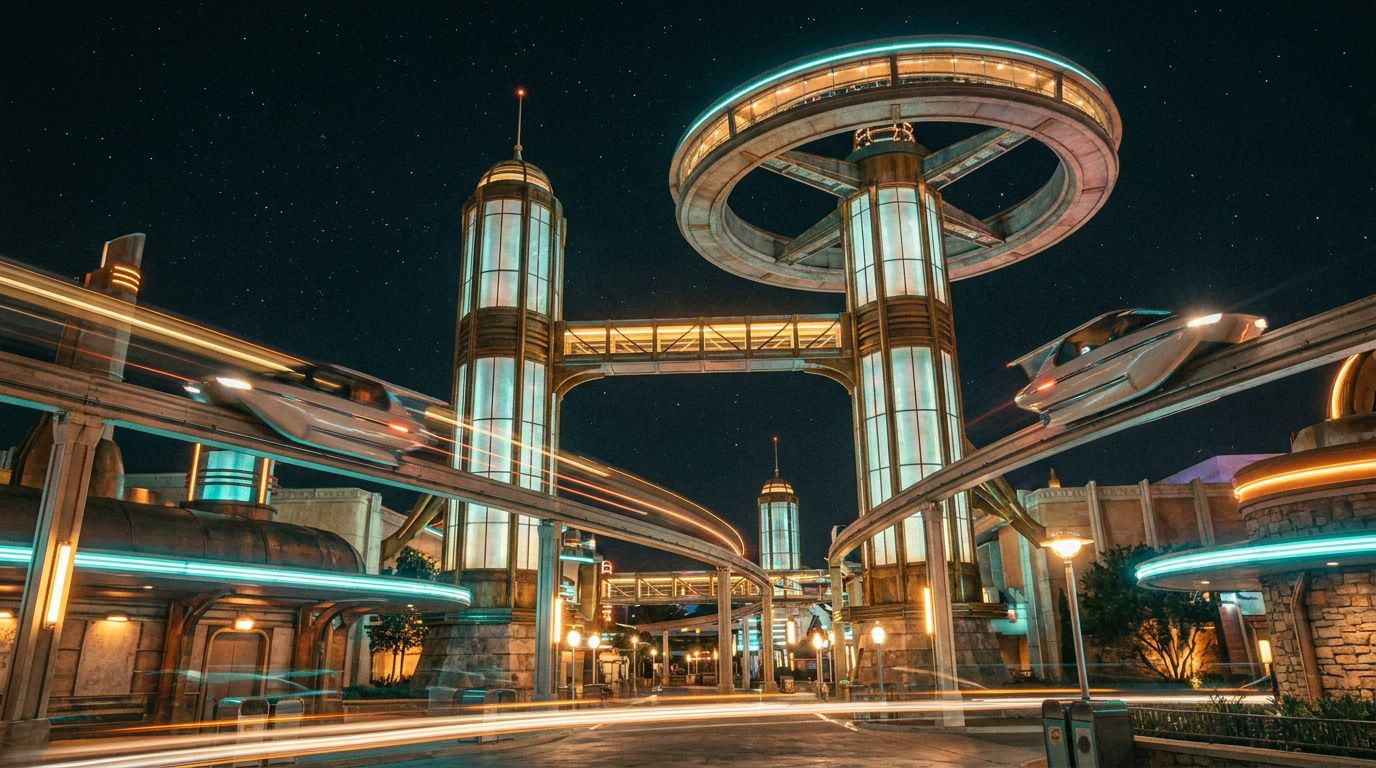
A retro-futuristic land at night: opalescent glass-and-brass towers linked by lit skybridges, glider vehicles on elevated rails, and a rotating observation ring.
Skyward Reach around ten. The towers hum a chord. Nobody will tell me which one.

LAND V — THE OPTIMIST'S FUTURE

Skyward Reach

The 1960s future that never arrived, built full scale and left running: opal towers, brass elevators, personal gliders on singing rails, and the twins underfoot, maintaining a rivalry with more institutional memory than most governments. Everything here works a little too smoothly, and then a robot deliberately unfixes something, and the land makes sense again.

  • The glider rails — your own slow flying machine. Go at night.
  • The Observatory Ring — the whole park rotating past you, once per twenty minutes.
  • The twins' workshop — calling hours chalked on the door, faction stickers on the frame.
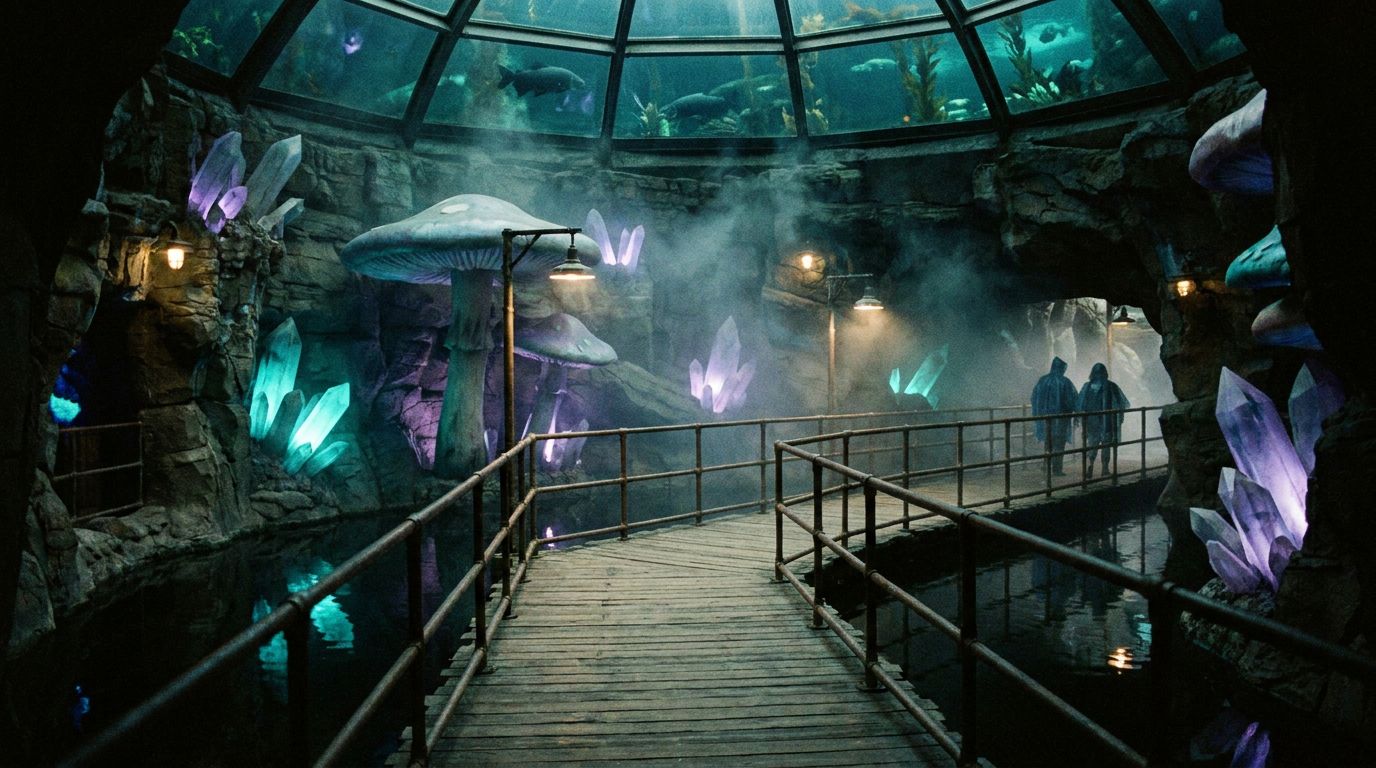
A dim boardwalk winding over black water through giant glowing teal and violet mushrooms and crystals beneath a vaulted glass ceiling.
The Undermere. Gorgeous. Would not want to be the last one out. Have deliberately been the last one out twice.

LAND VI — BENEATH THE LAKE

The Undermere

Under the lake itself, and — let me be clear, because the brochures won't — intentionally a little eerie. Cold air, black water, glowing things, a glass ceiling with slow fish overhead, and Seren somewhere in the dark knowing your name. It opens when she wakes it at 8:47 and closes last of anything. Children adore it for the same reason they adore being slightly scared under a blanket.

  • The Naming of Stars — the dark ride. Chapter Four. Bring someone you like.
  • The pearl boats — an underground river with nowhere in particular to be.
  • The waking, 8:47 — cavern by cavern. Stand in the third one.

If the moth whispers "mind the third step," mind the third step. There is no third step. Mind it anyway.

Chapter Four · The rides

One of everything, done properly

The engineering pattern here is easy to spot once you see it: take the best ride system operating anywhere on Earth and build exactly one definitive example. No clones, no sequels, no B-side. I've listed the majors; the minors are yours to find.

The Kindling

Emberpeak

Triple-launch coaster through the mountain's interior, out a steam vent, and behind the big waterfall close enough to feel the cold. The last launch happens in the dark with the caldera glowing somewhere above you. Sit left, row three. The waterfall moment only works on the left.

96 mph1.9 mi3 launches

The Naming of Stars

The Undermere

Trackless boats on robotic arms drifting over black water while Seren narrates just quietly enough that the whole boat leans in. In the last chamber the ceiling becomes sky, one star brightens, and it's named for someone aboard — entered in a real registry. People come back years later to visit their star. I've watched them do it. Nobody talks on the way out.

Trackless12 minBring a sleeve

Alow & Aloft

Skyward Reach

Double-decker flying theater — two gondola rigs stacked in one 120-foot dome — that flies the valley from lakebed to cloud line. When it rains on screen you smell petrichor two seconds early. The upper deck is marginally better and everyone knows it, so the residents run a coin flip at the split. Bolt calls it. Rivet disputes the coin.

Flying theater120 ft domeTeam Rivet

The Long Way Home

Hearthwood

Twenty-five minutes of slow boat under the oaks, past cottage gardens, through the fireflies, cocoa aboard. Residents wave from their yards if they're out, and don't if they're not, which is somehow better. If a boat waves Pip aboard he'll ride a stretch, claiming it's a shortcut. It is not a shortcut. That's the name.

25 minCocoa $2Dusk sailing

Emberrun

Emberpeak → Tidegate

Mine train inside the mountain, whitewater in the gorge, harbor boat past the dinner tables — four ride systems, one amphibious vehicle, no seams you can find. The Tidegate diners rate each boat's splash on chalkboards. This is not sanctioned. It is also not stopped.

4 systemsAmphibiousChalkboard jury

The Ferry Lights

The Lake

The lake ferry at dusk, when the Order is out and the lanterns come on shore by shore. Not technically a ride. The best thing in the park. Both statements are true and the captain is tired of the argument.

FreeContinuous8 PM sharp-ish

On waiting

There are no switchback queues at Crossroads — not shaded ones, not themed ones, none. Every ride runs a virtual queue with an honest estimate, and the walk-up to each one is a garden, a cave, or a pre-show you'd loiter in anyway. The posted numbers round up: if it says eleven minutes it's ten. I've timed it for years out of spite and they have never once lied to me, which at this point I find almost rude.

Chapter Five · Eating

Street prices, ridiculous kitchens

Every stall has a named cook, a real kitchen, and one thing it does better than anywhere else in the park. The most expensive thing a child can want is six dollars. Water is free everywhere. Any dish can be remade in the allergen-isolated kitchen — same dish, same price, no asterisks. I've tested this with a fussier travel companion than I care to describe.

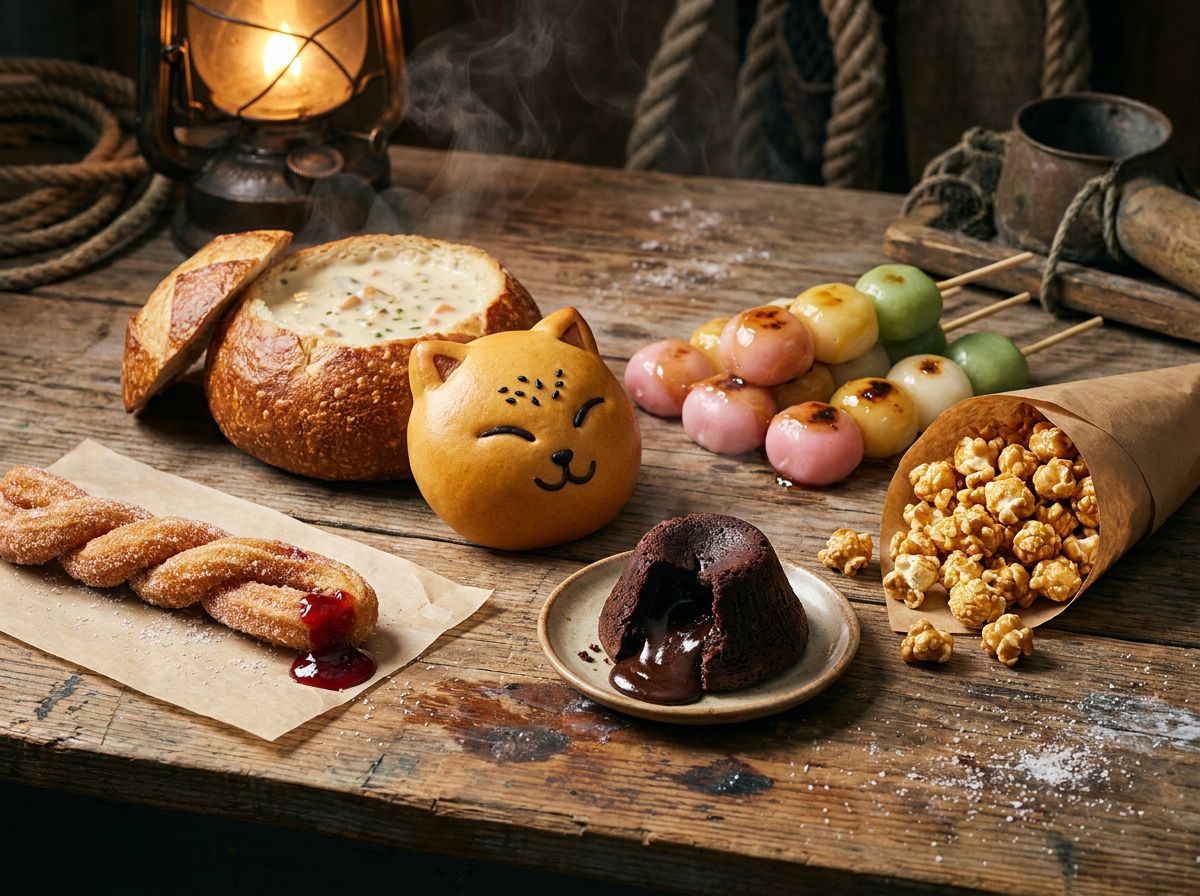
Overhead photo of harbor-table food at lantern light: chowder in a bread bowl, a fox-shaped steamed bun, mochi skewers, a stuffed churro, a tiny molten chocolate volcano, and caramel popcorn.
One night's damage at the night market. The fox bun is looking at you and you will eat it anyway.

From the night market

What to actually order

The menu rotates with the seasons except for five items the park designated Permanent after the fox bun petition of 2029 — eleven thousand signatures, park surrendered in four days, the framed petition hangs in the Bakehouse. The list below is my standing order, refined over eleven years and defended in print against all correspondence.

Skip lunch on your Tidegate day. You'll want the room. This is the single most useful sentence in this book.

Chapter Six · Things I've noticed

The park you're not supposed to see

Eleven years of paying attention, condensed. None of this is secret — ask any cast member and they'll cheerfully confirm — but all of it is invisible until someone points, so: pointing.

01The bricks lie

Every facade shrinks as it rises — full scale at the street, smaller above, smaller still above that — so the whole park reads taller and more storybook than it is. Once you see it you can't unsee it. Sorry.

02The berm

A forested earthwork rings the valley. No rooftops, no towers, no traffic hum, no world. I once climbed the ferry's top deck specifically to catch a glimpse of outside. You can't. I checked with binoculars. A cast member watched me do this and said, gently, "we know."

03The second floor

The whole park is the second floor; a full service level runs beneath it. Deliveries, costumes, cables — all of it underground. In eleven years I have never seen a truck, a crate, or a resident somewhere they shouldn't be.

04The air is plumbed

Bread and beeswax on the Meridian. Moss and rain in Hearthwood. Charcoal and citrus at the harbor. Cold stone below the lake. Stand at any land border and walk ten paces: the crossfade is real and it's timed to the music.

05You never hear two songs

Nineteen hundred speakers, give or take, and the area scores crossfade so cleanly you can't stand in the overlap. I have tried to find the seam for years. My spouse no longer comes on these walks.

06The dawn swap

Flowerbeds are never roped off and never "resting" — the night crew swaps entire beds in bloom before gates. I saw the tulip incident referenced on the ticker. I have questions. The gardeners do not accept questions.

07Twelve steps

No trash can is more than twelve steps away — the old Disney measurement — and the actual disposal is pneumatic, under the pavement. The cans are a polite fiction. The park is riddled with polite fictions. It's load-bearing politeness.

08The night shift

Everything a hand can reach is inspected and touched up nightly; the pavement is washed warm by four. If you take the first ferry you can still smell it. That's not a metaphor. The park smells faintly of clean stone until about nine.

Chapter Seven · Small mercies

Things I have personally witnessed

Not marketing copy — field notes. Every one of these is something I've watched happen to an actual family, usually one having a worse day than mine.

Rain ponchos, free, instantly

The sky opens and staff appear at every door with ponchos before the second drop, on the stated theory that the park picked an outdoor valley so the weather is the park's fault. Cocoa carts follow within minutes.

Last ride rides twice

The final boat, train, and glider of every night goes again immediately, no re-queue. I've been the beneficiary three times and it never stops feeling like getting away with something.

Every photo is free

Ride photos, roaming photographers, all of it, full resolution, forever. There is no photo counter because there is nothing to sell you.

The birthday pin

Wear the free pin and residents find you all day, building to a finale. Skip it and your birthday remains your business. I watched a teenager weigh this choice at the gate for a solid minute. She took the pin. Correct.

Quiet rooms, no questions

A staffed dim room in every land, plus a sensory map of the park in the app and on paper. I've seen an overwhelmed kid walked in mid-meltdown and carried out asleep, and nobody involved acted like anything unusual had occurred.

Watch-with-me benches

Every ride exit has shaded benches with a live view of the ride, so the waiting parent watches their kid's face on the drop. Rider swap requires saying the words "rider swap." That's the whole system.

The language pins

Staff wear pins for every language they speak — forty-some on a good day — and every performer signs. I watched a deaf kid have a full conversation with a fox and walk away vibrating.

Free lockers, cold medicine fridges

Lockers free and sized for real life; medication fridges at every first-aid post, no forms. The one time I needed the fridge, the staffer's entire reaction was pointing at it.

The kennel webcam

Shaded, staffed kennel with a live camera. I have watched grown adults check the dog feed from the Observatory Ring with tears in their eyes. The dog was fine. The dog is always fine. The dog has friends now.

Re-entry, always

Leave, nap, come back for the Lantern Hours. The ticket is for the day, not for your continuous physical custody. Locals treat the afternoon nap as canon.

The gate fund

A pay-it-forward fund covers tickets for families who can't — no application, a teacher's letter is plenty. It's mentioned nowhere official. You find out by being behind someone at the gate, once, and then you never stop putting change in.

Honest numbers

Posted waits round up. Posted prices are the prices. The ferry is "8 PM sharp-ish" and departs accordingly. A park that won't lie about small things earns a suspicious amount of slack on the large ones, such as where the money comes from.
Closing time · 10 PM

The Lantern Hours

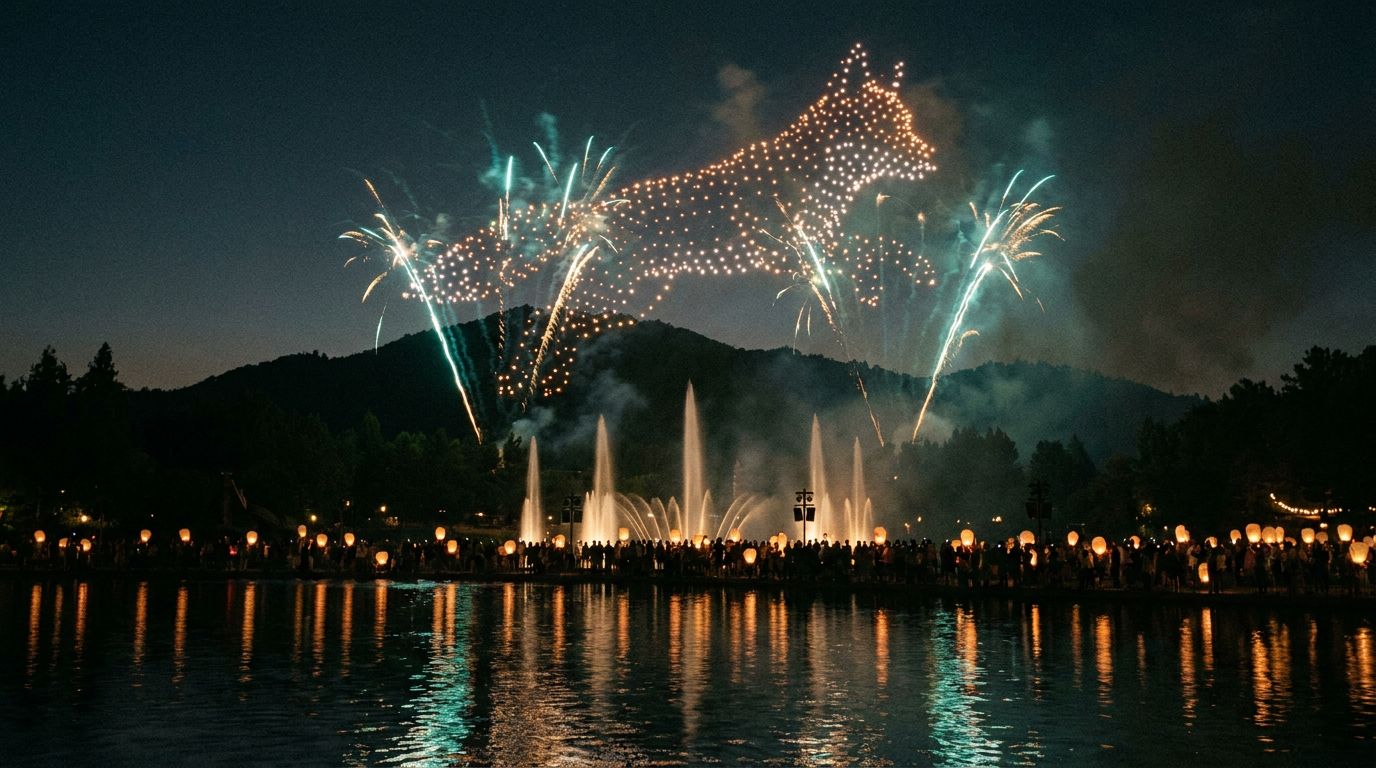
At dusk everyone gets a paper lantern. At ten the lake goes dark, the drones come off the water, and the fountains answer them. The show changes with the seasons; lately the finale is a fox, for reasons the harbor gossip attributes to a certain magpie's lobbying. It ends when the drones come down to meet forty thousand raised lanterns at the shoreline, and then everybody walks to the ferry very quietly.

I can't photograph what it feels like, so here's a toy version instead. Tap the sky. The fireworks are on me.

Night photo over the lake: drone lights forming a giant leaping fox above the dark mountain, illuminated fountains, teal and gold fireworks, and a lantern-holding crowd along the shore.

Tap the sky for fireworks